
2025 EAB Biometrics Awards
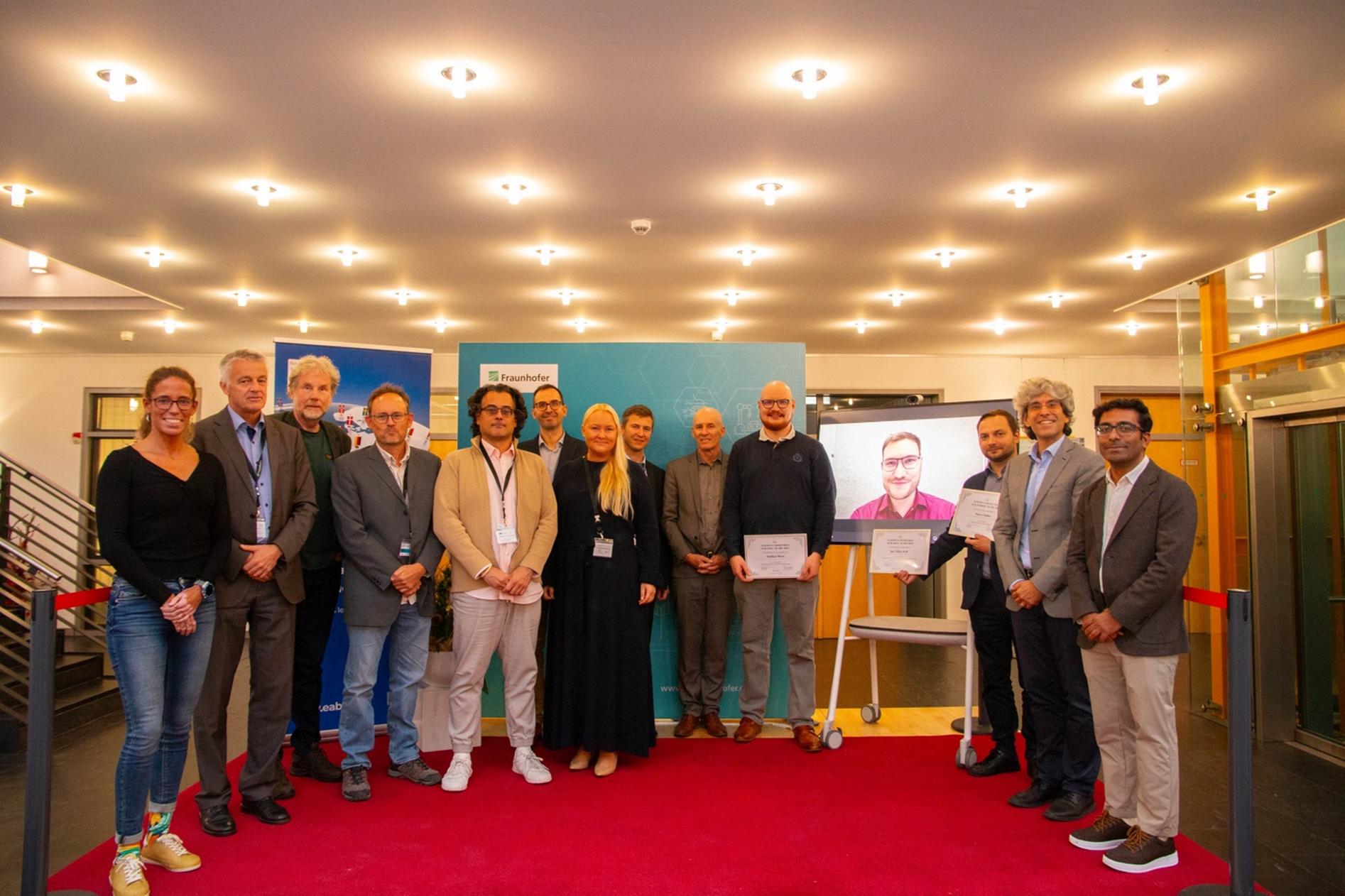 The winners of the European Biometrics Awards 2025 alongside members of the jury and the European Association for Biometrics.
Winners of the 19th European Biometrics Max Snijder, Research, and Industry Awards
Darmstadt, Germany, 2025-09-24
On the 24th of September 2025, during the 19th edition of the European Biometrics Max Snijder, Research, and Industry Awards, the European Association for Biometrics (EAB) awarded three young researchers for their outstanding contributions to the field of biometrics. From a wide range of high-quality submissions, an international jury of experts shortlisted three finalists, who were invited to present their work to the jury, EAB members, and a public audience.
European Biometrics Max Snijder Award
This year's Max Snijder Award went to Marco Huber from Fraunhofer Institute for Computer Graphics Research IGD (Germany), for his paper “Towards Trustworthy Face Recognition”. Huber’s research addresses the challenge of making deep learning-based face recognition systems transparent and trustworthy through comprehensive explainability methods.
This research addresses the often-overlooked opacity of deep learning-based face recognition systems by introducing methods that make their decisions more interpretable and reliable. Huber first developed a framework to quantify uncertainty and decision confidence that allows systems to express how certain they are in verification outcomes to use this information to improve further performance. Furthermore, he proposes xSSAB, a gradient-based explainability technique that generates heatmaps linked not only to similarity but also to the system’s decision threshold, thereby providing clearer insight into why two images are judged as a match or non-match. This method was further applied to study ethnicity-related bias and revealed how different models process demographic groups differently. Lastly, Huber introduces “frequency heat plots” that reveal the impact of frequency components on face recognition decisions. These findings were successfully used to analyze model bias and to develop a novel, training-free countermeasure against face morphing attacks.
Huber’s work therefore establishes new methodological foundations for trustworthy face recognition systems. Particularly, this research demonstrates how explainability can strengthen security and fairness in biometric technologies.
![[Photo] Winner of the Max-Snijder-Award Marco Huber: Towards Trustworthy Face Recognition](/images/photos/award2025/2025-eab-awards-Marco_Huber.jpg "Winner of the Max-Snijder-Award Marco Huber: Towards Trustworthy Face Recognition") Winner of the Max-Snijder-Award Marco Huber: Towards Trustworthy Face Recognition.
Winner of the Max-Snijder-Award Marco Huber: Towards Trustworthy Face Recognition.
European Biometrics Research Award
The Industry Award went to Mathias Ibsen from Darmstadt University of Applied Sciences (Germany) for his paper “Differential Anomaly Detection for Facial Images” that addresses one of the main vulnerabilities of face recognition technologies: identity attacks (attack presentations (APs)).
Ibsen’s work introduces a unified differential anomaly detection framework that departs from traditional binary classification approaches. Instead of training models on examples of both genuine and attack presentations, Ibsen’s framework learns only from bona fide data (bona fide presentations (BPs)), capturing the natural variations that occur in an individual’s facial appearance (e.g., due to lighting, pose, or ageing). Therefore, unnatural deviations, such as those caused by face morphing, swapping, retouching, silicone masks, or makeup impersonation, are then detected as anomalies.
Ibsen’s approach uses deep face embeddings extracted from pairs of images (reference and probe), which are combined and analyzed using anomaly detection models. Furthermore, empirical evaluation demonstrates strong generalization to unknown attack types, particularly achieving near-zero error rates for face swaps, morphing and physical mask attacks. Although anomaly detection performance on subtle retouching was lower (i.e., BPCER greater than 40.0% for an APCER of 1.0%), these manipulations posed only limited security risks in biometric systems.
All in all, Ibsen’s work contributes to enhancing the trustworthiness of face recognition systems by offering a scalable anomaly detection framework for identity attacks.
![[Photo] Winner of the EAB Research Award Mathias Ibsen: Differential Anomaly Detection for Facial Images](/images/photos/award2025/2025-eab-awards-Mathias_Ibsen.jpg "Winner of the EAB Research Award Mathias Ibsen: Differential Anomaly Detection for Facial Images") Winner of the EAB Research Award Mathias Ibsen: Differential Anomaly Detection for Facial Images
Winner of the EAB Research Award Mathias Ibsen: Differential Anomaly Detection for Facial Images
European Biometrics Industry Award
The winner of the Research Award is Jan Niklas Kolf from the Fraunhofer Institute for Computer Graphics Research IGD (Germany), for his paper: “Towards Efficient Face Recognition: Deep Learning Models for Identity and Quality Assessment”. Additionally, he received the Best Presentation Award. Kolf’s research findings present three major innovations that help solve two main challenges in face recognition (FR) technology: the high computational demands of deep learning models and the ethical and legal constraints that relate to the usage of biometric data.
Firstly, GraFIQs, a novel method for face image quality assessment, eliminates the need for additional training or labelled data by proposing a novel conceptual view on the interaction between face images and a FR model by using gradient magnitudes from existing FR models as a quality indication. By using GraFIQs, it enables efficient, scalable and accurate quality assessment with reduced computational costs. Secondly, Kolf introduces IDnet, namely, an identity-driven generative framework for producing synthetic, privacy-preserving datasets that are optimized specifically for FR training. Given that IDnet is conditioned on identity rather than class, IDnet achieves robust synthetic identities that strengthen FR performance while protecting users’ biometric data. Thirdly, QUD develops an unsupervised knowledge distillation technique that transfers knowledge from computationally intensive teacher models to compact student models without requiring labels or shared feature spaces. Thus, in doing so, QUD allows the deployment of high-performing FR systems on resource-constrained devices, such as smartphones.
Further, Kolf has introduced key innovations in the design and development of resource-efficient approaches for periocular recognition within a privacy-preserving framework. These contributions include Lightweight periocular recognition enabled by low-bit quantization, Synthetic periocular data generation to support quantized lightweight recognition in both the NIR and visible domains, and MixQuantBio, a method for extreme compression of face and periocular recognition models through mixed-precision quantization.
Altogether, Kolf’s contributions help advance the efficiency, privacy and scalability of face recognition systems. His work addresses computational and data-related limitations directly and establishes ethically responsible pathways for the broader and more equitable deployment of biometric technologies.
![[Photo] Winner of the EAB Industry Jan Niklas Kolf: Towards Efficient Face Recognition: Deep Learning Models for Identity and Quality Assessment](/images/photos/award2025/2025-eab-awards-Jan_Niklas_Kolf.jpg "Winner of the EAB Industry Jan Niklas Kolf: Towards Efficient Face Recognition: Deep Learning Models for Identity and Quality Assessment") Winner of the EAB Industry Jan Niklas Kolf: Towards Efficient Face Recognition: Deep Learning Models for Identity and Quality Assessment
Winner of the EAB Industry Jan Niklas Kolf: Towards Efficient Face Recognition: Deep Learning Models for Identity and Quality Assessment
The European Biometrics Awards have a total value of €4.000,00, which is divided amongst the winners. The finalists are also awarded a complimentary one-year membership to the EAB. This year's Industry Award was kindly sponsored by IDEMIA.
The selection of the Research Award is made on the basis of academic and scientific quality of the submitted works as well as the quality of the presentations. A separate selection is made during the final presentation to appoint the winners of the Industry and Max Snijder Awards. Next to its scientific quality, the criteria for the Industry Award considers the novelty, impact, applicability and other business aspects of the submitted works.
The European Biometrics Awards are granted annually to individuals who make a significant contribution to the field of biometrics research in Europe. Their goal is to stimulate and promote innovation and research in the field of Identity and Biometrics in Europe.
EAB members can find the summaries of the theses of the winners in the Hall of Fame.
The call for submissions for the European Biometrics Max Snijder, Research, and Industry Awards 2025 has been published and is available at eab.org/award.